ACADEMIC

"We hope that libraries will always exist as places for learners to find information, resources, services, and instruction. But formats, technologies, learning needs, and our schools are evolving. And so are students themselves. Our entire information and communication landscapes have shifted-and this shift will only continue."
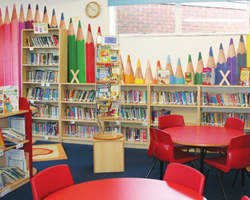
The presence of a school library is a vital component of a student's education. The school library is central to learning and plays a key role as a place for encouraging innovation, curiosity, and problem solving Library is a catalyst for literacy and reading and for teaching and scaffolding inquiry learning. School libraries make a difference to students' understanding and achievement and provide support for teaching and learning throughout the school. The school library is an important part of the school community and reflects and welcomes this community. Keeping the significance of school library in mind, RVIEHS has set up a library with 3500 books as on date along with magazines, periodicals and newspapers. Our RVIEHS library's services and operations provide a welcoming learning environment that reflects the key competencies and values of the RVIEHS curriculum and the culture, community and “special character” of the school in supporting student needs. The library's online presence provides a portal for accessing the library's collections print and digital, external databases and web-based tools and resources within and beyond the school, and promotes effective search strategies. The library is always open during school hours with both fixed and flexible timetable options for classes, small groups and individuals. The library's resources are available for loan to students and teachers for use within the school and at home, according to borrowing guidelines in the Library handbook. As part of our school's home-school partnership, the library is a place for the whole school community, pre-scholars and parents are encouraged to explore, and use the library.
In recent years internet has revolutionized the concept of library. Information technology now plays an important role in improving the library facilities.
With the growing popularity of internet, which provides loads of information with just a click of a mouse, one may pause to think about the decreasing relevance and importance of a library in today's world. But one should keep in mind that a person goes to a library not only to search and get information from books but also to sit and study there. The ambience and the peaceful and scholarly atmosphere then helps one to concentrate more on one's work and study. Thus, libraries will never become redundant. They will always be there to indicate the presence of a well-read and educated society.
HOW SCIENCE LABORATORIES ARE USED IN SECONDARY SCHOOLS
IN RVIEHS
Education in the largest sense is an
act or experience that has a formative effect on the mind,
character of physical ability of an individual, in its technical
sense it is the process by which society deliberately transmit
it accumulated knowledge, skills and value from one generation
to another. Since education is a concept also refer to the
process in which students are instructed, in taught to acquired
or learn specific knowledge, skills, or ability that can be
applied to real life situation upon completion, it has become
fashionable and divide education into different learning
“models”. Laboratory work is considered essential in promoting
students' learning of science and of scientific inquiry. What
the students perceive as important to learn from a regular
laboratory exercise is probably affected by the teacher's
objectives. We study the extent to which one teacher's
objectives are fulfilled during lab work, and how
teacher-student and student-student interactions contribute to
developing learning experiences from the laboratory exercise. Do
students encounter opportunities to learn in agreement with the
teacher's objectives? Our results point to the importance of
teacher involvement to help students understand what to look
for, how to do it and why. Especially teacher-student
interactions during lab work seemed to influence what students
perceived as important to learn. In the laboratory exercise in
this case, the teacher helped the students to observe and to use
their observations in their explanations. The lab work included
learning experiences other than those addressed by the teacher,
and the teacher's intentions were partially fulfilled. Not only
what the teacher says, but also how the teacher acts is
important to help students understand what to learn from a
laboratory exercise.
WE HAVE THE FOLLOWING LABORATORIES IN RVIEHS
RESPECTIVELY:
PHYSICS: "Newton won a stunning
victory for the intellect and the democratization of science,
because it became possible for students to have as much
authority as teachers. By knowing proper methods, a youth could
conduct an experiment whose results might confound his elders."1
Newton's program of "experimental philosophy" firmly and
successfully established the central methods of physics, whereby
inference from experience guides formulation of hypotheses,
whose predictions are validated by experiment. Laboratory
activities in high school physics provide experience with
phenomena, a starting place for the systematic development of
students' ideas, and a testing ground for the predictive power
of their reasoning.
CHEMISTRY: Chemistry is at the heart of environmental issues. What makes one chemical a nutrient and another chemical a pollutant? How we can clean up the environment? What processes can produce the things our need without harming the environment? We're all chemists. We use chemicals every day and perform chemical reactions without thinking much about them. Chemistry is important because everything you do is chemistry! Even our body is made of chemicals. Chemical reactions occur when we breathe, eat, or just sit there reading. All matter is made of chemicals, so the importance of chemistry is that it's the study of everything.
BIOLOGY: Biology is a natural science concerned with the study of life and living organism s, including their structure, function, growth, origin, evolution, distribution, and taxonomy. Biology is a vast subject containing many subdivisions, topics, and disciplines. Biology in definition means the study of life. If we didn't have biology, we wouldn't understand any of the basic concepts of being a species. We'd still be clapping our hands at fire.
COMPUTER: Students' learning process is significantly richer today, because they integrated computer technology-based projects in their curriculum. Technology is an important element in grade school curriculum since it helps create a learning environment in which students are more confident and productive as they engage in projects that empower them to take ownership of their education.