Our Ideals

Sri Ramakrishna was born on 18 February 1836 in the village of Kamarpukur about sixty miles northwest of Kolkata. His parents, Kshudiram Chattopadhyaya and Chandramani Devi, were poor but very pious and virtuous. As a child, Ramakrishna (his childhood name was Gadadhar) was dearly loved by the villagers. From early days, he was disinclined towards formal education and worldly affairs. He was, however, a talented boy, and could sing and paint well. He was fond of serving holy men and listening to their discourses. He was also very often found to be absorbed in spiritual moods. At the age of six, he experienced the first ecstasy while watching a flight of white cranes moving against the background of black clouds. This tendency to enter into ecstasy intensified with age. His father's death when he was seven years old served only to deepen his introspection and increase his detachment from the world.
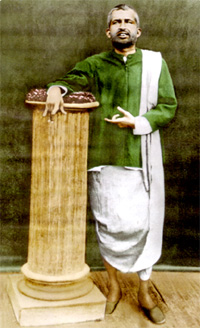
As a Priest at Dakshineswar Temple
When Sri
Ramakrishna was sixteen, his brother Ramkumar took him to
Kolkata to assist him in his priestly profession. In 1855 the
Kali Temple at Dakshineswar built by Rani Rasmani was
consecrated and Ramkumar became the chief priest in that temple.
When he died a few months later, Ramakrishna was appointed the
priest. Ramakrishna developed intense devotion to Mother Kali
and spent hours in loving adoration of her image, forgetting the
rituals of priestly duties. His intense longing culminated in
the vision of Mother Kali as boundless effulgence engulfing
everything around him.
Intense Spiritual Practices
Sri
Ramakrishna's God-intoxicated state alarmed his relatives in
Kamarpukur and they got him married to Saradamani, a girl from
the neighbouring village of Jayrambati. Unaffected by the
marriage, Sri Ramakrishna plunged into even more intense
spiritual practices. Impelled by a strong inner urge to
experience different aspects of God he followed, with the help
of a series of Gurus, the various paths described in the Hindu
scriptures, and realized God through each of them. The first
teacher to appear at Dakshineswar (in 1861) was a remarkable
woman known as Bhairavi Brahmani who was an advanced spiritual
adept, well versed in scriptures. With her help Sri Ramakrishna
practised various difficult disciplines of theTantrik path, and
attained success in all of them. Three years later came a
wandering monk by name Totapuri, under whose guidance Sri
Ramakrishna attained Nirvikalpa Samadhi, the highest spiritual
experience mentioned in the Hindu scriptures. He remained in
that state of non-dual existence for six months without the
least awareness of even his own body. In this way, Sri
Ramakrishna relived the entire range of spiritual experiences of
more than three thousand years of Hindu religion.
Following Other Faiths
With his
unquenchable thirst for God, Sri Ramakrishna broke the frontiers
of Hinduism, glided through the paths of Islam and Christianity,
and attained the highest realization through each of them in a
short span of time. He looked upon Jesus and Buddha as
incarnations of God, and venerated the ten Sikh Gurus. He
expressed the quintessence of his twelve-year-long spiritual
realizations in a simple dictum: Yato mat, tato path "As many
faiths, so many paths." He now habitually lived in an exalted
state of consciousness in which he saw God in all beings.
Worshipping His Wife
RamakrishnaIn 1872,
his wife Sarada, now nineteen years old, came from the village
to meet him. He received her cordially, and taught her how to
attend to household duties and at the same time lead an
intensely spiritual life. One night he worshipped her as the
Divine Mother in his room at the Dakshineswar temple. Although
Sarada continued to stay with him, they lived immaculately pure
lives, and their marital relationship was purely spiritual. It
should be mentioned here that Sri Ramakrishna had been ordained
a Sannyasin (Hindu monk), and he observed the basic vows of a
monk to perfection. But outwardly he lived like a lay man,
humble, loving and with childlike simplicity. During Sri
Ramakrishna's stay at Dakshineswar, Rani Rasmani first acted as
his patron. After her death, her son-in-law Mathur Nath Biswas
took care of his needs.
Contact with Some Notables
Sri
Ramakrishna's name as an illumined saint began to spread. Mathur
once convened an assembly of scholars, and they declared him to
be not an ordinary human being but the Avatar of the Modern Age.
In those days the socio-religious movement known as Brahmo
Samaj, founded by Raja Ram Mohan Roy, was at the height of
popularity in Bengal. Sri Ramakrishna came into contact with
several leaders and members of Brahmo Samaj and exerted much
influence on them. His teaching on harmony of religions
attracted people belonging to different denominations, and
Dakshineswar became a veritable Parliament of Religions.
Coming of the Devotees
As bees swarm
around a fully blossomed flower, devotees now started coming to
Sri Ramakrishna. He divided them into two categories. The first
one consisted of householders. He taught them how to realize God
while living in the world and discharging their family duties.
The other more important category was a band of educated youths,
mostly from the middle class families of Bengal, whom he trained
to become monks and to be the torchbearers of his message to
mankind. The foremost among them was Narendranath, who years
later, as Swami Vivekananda, carried the universal message of
Vedanta to different parts of the world, revitalized Hinduism,
and awakened the soul of India.
RamakrishnaThe Gospel of Sri Ramakrishna
Sri Ramakrishna did not write any book, nor did he deliver
public lectures. Instead, he chose to speak in a simple language
using parables and metaphors by way of illustration, drawn from
the observation of nature and ordinary things of daily use. His
conversations were charming and attracted the cultural elite of
Bengal. These conversations were noted down by his disciple
Mahendranath Gupta who published them in the form of a book, Sri
Sri Ramakrishna Kathamrita in Bengali. Its English rendering,
The Gospel of Sri Ramakrishna, was released in 1942; it
continues to be increasingly popular to this day on account of
its universal appeal and relevance.
Last Days
The intensity of his spiritual
life and untiring spiritual ministration to the endless stream
of seekers told on Sri Ramakrishna's health. He developed cancer
of the throat in 1885. He was shifted to a spacious suburban
villa where his young disciples nursed him day and night. He
instilled in them love for one another, and thus laid the
foundation for the future monastic brotherhood known as
Ramakrishna Math. In the small hours of 16 August 1886 Sri
Ramakrishna gave up his physical body, uttering the name of the
Divine Mother, and passed into Eternity.